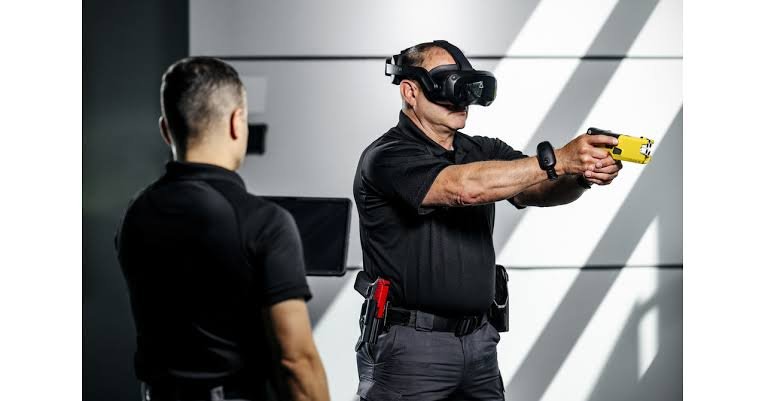
Law enforcement agencies are continuously looking for better ways to prepare officers for the unpredictable situations they may encounter on duty. Conventional training approaches, including classroom instruction, recorded decision-making videos, firearms practice, and occasional role-playing exercises, can provide valuable experience but may not fully reproduce the intensity and uncertainty of real-world encounters. Hence, the use of portable VR training simulator for law enforcement has become increasingly common. Such virtual reality (VR) powered simulators allows agencies to recreate demanding situations in a controlled and repeatable environment.
How portable VR training simulators are transforming law enforcement preparedness
One of the strongest advantages of using portable VR training simulator for law enforcement training is its flexibility. Law enforcement agencies frequently face practical challenges when organizing training sessions. Access to specialized facilities may be limited, training ranges can be expensive, and arranging actors or instructors for realistic scenarios requires significant coordination. In addition, officers may have difficulty traveling to centralized training facilities because of staffing schedules and operational responsibilities. Portable VR systems help address many of these limitations by bringing the training environment directly to the agency. Modern equipment can often be transported and assembled with minimal effort. A training session may be conducted in a conference room, classroom, gym, briefing area, or another suitably sized indoor location. Once the session is complete, the equipment can be packed away and moved elsewhere. This flexibility can make training easier to schedule and potentially increase how frequently officers participate in realistic simulations. Rather than relying exclusively on occasional large-scale exercises, departments can incorporate shorter VR sessions into their regular training schedules.
Traditional video-based simulators often depend on predetermined storyline. Officers may watch a scenario, make a selection, and then see one of several prerecorded outcomes. Although this approach can teach important concepts, repeating the same exercise can eventually make the experience predictable. Participants may begin remembering the expected answers instead of genuinely evaluating the circumstances presented to them. Modern VR platforms offer a more immersive alternative. Three-dimensional environments can allow trainees to look around, move through virtual spaces, interact with characters, and respond to changing circumstances. Instead of simply selecting an option from a screen, participants can experience a situation that develops according to their actions and communication. This type of training can be useful for practicing decision-making, communication, crisis response, de-escalation, and situational awareness. It also allows different skills to be combined into one exercise. An officer may need to observe a developing situation, communicate with another person, assess potential risks, request assistance, and determine an appropriate response rather than practicing each skill separately.
A major benefit of modern VR training platforms is the ability to customize scenarios. A department does not necessarily have to depend entirely on a library of generic exercises. Scenario-building tools can allow instructors or training coordinators to create environments that reflect the agency’s specific needs. This helps make training more relevant. The ability to adjust environments, characters, circumstances, and outcomes gives instructors greater control over the training experience.